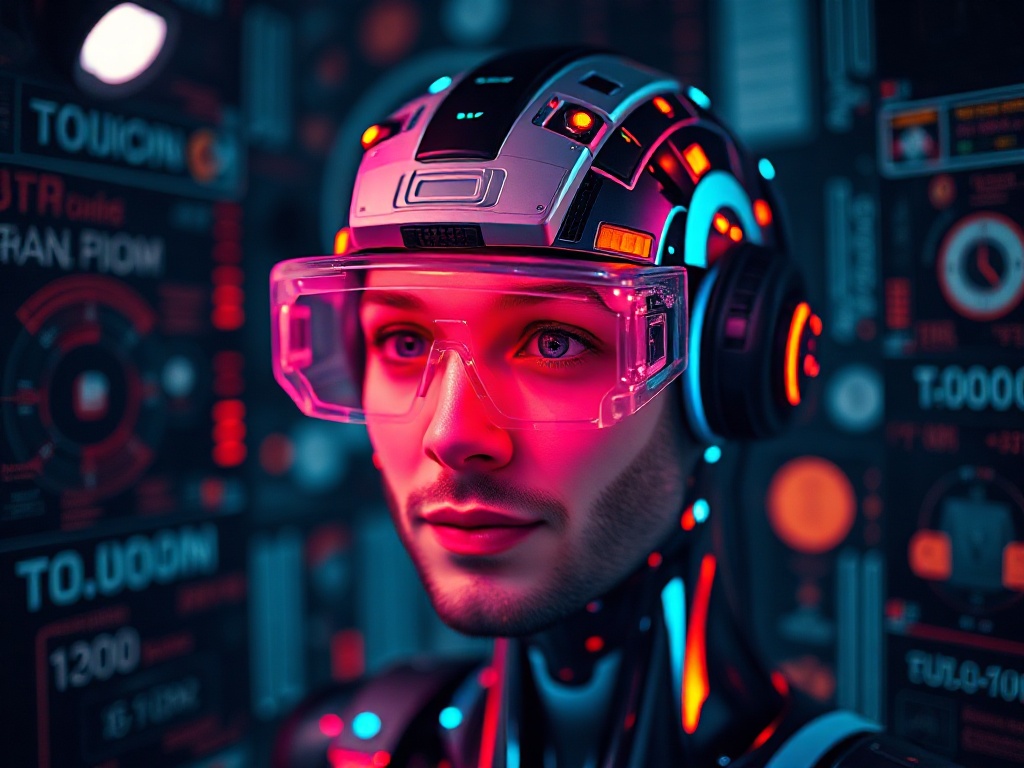
Multimodal AI: Vision, Text, and Audio Fusion for a Smarter Future
Artificial intelligence is rapidly evolving, moving beyond specialized tasks to embrace a more holistic understanding of the world. The next frontier in this evolution is Multimodal AI, a revolutionary approach that integrates information from diverse sources like vision, text, and audio. Unlike unimodal systems that process one type of data in isolation, multimodal AI mimics human perception, allowing machines to interpret complex real-world scenarios with unprecedented accuracy and context. This convergence of sensory data is paving the way for AI systems that can not only see, hear, and read, but truly comprehend, enabling a new generation of intelligent applications.
The Dawn of Multimodal AI: Beyond Unimodal Limitations
For years, AI development largely focused on unimodal systems, excelling in specific domains such as natural language processing (NLP) for text, computer vision for images, or speech recognition for audio. While these systems achieved impressive feats within their respective silos, their inherent limitation became clear when confronted with the richness and complexity of human interaction and real-world environments. A system that understands text but cannot interpret accompanying images, or one that recognizes speech but misses visual cues, operates with an incomplete picture. Multimodal AI emerges as the critical solution to overcome these constraints. By training models to process and correlate data from multiple modalities simultaneously, AI can build a much more comprehensive and nuanced understanding, mirroring how humans perceive and interact with their surroundings. This fusion provides a richer context, leading to more robust, reliable, and genuinely intelligent systems that can perceive the world in a more human-like manner.
How Vision, Text, and Audio Converge
The convergence of vision, text, and audio in multimodal AI is a sophisticated process, typically achieved through advanced deep learning architectures designed to extract and integrate features from disparate data types. The core challenge lies in translating these varied inputs – pixels from images, sequences of words, and waveforms of sound – into a common, semantically rich representation within a shared embedding space. Techniques like self-attention and cross-attention mechanisms, often powered by transformer networks, play a crucial role, allowing the model to weigh the importance of information across modalities and discover intricate relationships. This enables AI to understand how a specific visual element relates to a spoken command or a piece of text, creating a coherent, unified perception that transcends the limitations of individual sensory inputs. The goal is not just to process multiple inputs, but to truly fuse them, enabling a deeper, contextual understanding.
- Vision-Text Integration: This involves training models to understand the relationship between images and descriptive text. Applications include image captioning (generating text descriptions for images), visual question answering (VQA) where AI answers questions about an image, and text-to-image generation, exemplified by models like DALL-E and Midjourney.
- Audio-Text Integration: Here, AI learns to connect spoken language with its textual representation. Key applications include highly accurate speech-to-text transcription, text-to-speech synthesis that produces natural-sounding voice, and sentiment analysis from voice recordings combined with transcribed text to gauge emotional tone.
- Vision-Audio Integration: This modality combination focuses on understanding events and contexts where both sight and sound are crucial. Examples include environmental sound classification within video clips, speaker identification from both visual cues (lip movements) and audio, and detecting specific events (e.g., a car crash) by analyzing both visual footage and accompanying sounds.
- Tri-Modal Fusion: The pinnacle of multimodal AI, this involves simultaneously processing and integrating vision, text, and audio data. It enables complex applications such as advanced human-computer interaction (understanding spoken commands, facial expressions, and textual context), comprehensive scene understanding in robotics, and creating immersive virtual reality experiences that respond to multiple sensory inputs.
Key Technologies Powering Multimodal AI
The advancements in multimodal AI are intrinsically linked to breakthroughs in several core machine learning technologies. At the forefront are **Transformer architectures**, which revolutionized natural language processing and have since proven incredibly effective in handling sequential data across modalities. Their self-attention mechanisms allow models to weigh the importance of different parts of an input, and cross-attention enables them to connect information between, say, an image and a text query, or a video and its audio track. **Contrastive learning** has also been a game-changer, particularly in models like CLIP (Contrastive Language–Image Pre-training). This technique trains models to learn robust representations by pushing similar multimodal pairs closer together in an embedding space while pushing dissimilar pairs apart. This allows for powerful zero-shot learning capabilities. Furthermore, **Generative Models**, such as Generative Adversarial Networks (GANs) and Variational Autoencoders (VAEs), underpin the ability to create new multimodal content, from generating images from text descriptions to synthesizing realistic speech from text. These foundational deep learning techniques, combined with vast datasets, are the engines driving the current multimodal AI revolution, allowing systems to not only understand but also generate complex, interconnected information across sensory types.
Transformative Applications Across Industries
Multimodal AI is not merely a theoretical concept; its practical applications are already transforming various industries, promising enhanced efficiency, safety, and user experience. In **healthcare**, multimodal AI can significantly improve diagnostics by correlating medical images (X-rays, MRIs) with patient health records, genetic data, and even doctors' notes, leading to more accurate and personalized treatment plans. In the **automotive sector**, particularly for autonomous vehicles, multimodal perception is critical. Self-driving cars fuse data from cameras (vision), lidar (depth), radar (distance), and even audio sensors (sirens, horns) to create a comprehensive understanding of their environment, enabling safer navigation and decision-making. **Education** stands to benefit from personalized learning systems that can assess student engagement not just through text responses but also through facial expressions and vocal tone, adapting teaching methods in real-time. **Customer service** is being revolutionized by virtual assistants that can understand not only spoken or typed queries but also interpret visual cues from video calls, offering more empathetic and effective support. In **accessibility**, multimodal AI provides invaluable tools, such as describing visual content for the visually impaired or transcribing speech in real-time with context derived from surrounding environmental sounds. Finally, the **media and entertainment industry** is leveraging multimodal AI for content creation, automatic video summarization, and generating realistic virtual characters that can see, hear, and respond.
Challenges and Future Directions
Despite its immense promise, multimodal AI faces several significant challenges that researchers are actively addressing. One of the primary hurdles is **data scarcity and alignment**. Creating large, high-quality datasets where different modalities are perfectly synchronized and semantically aligned (e.g., a video frame precisely matching a spoken word or a text description) is incredibly difficult and resource-intensive. Furthermore, the **computational cost** of training these increasingly complex models is staggering, requiring massive amounts of processing power and energy. **Ethical considerations** are also paramount; multimodal systems, if trained on biased data, can perpetuate and amplify societal prejudices, leading to unfair or discriminatory outcomes. Ensuring **interpretability** – understanding *how* these black-box models arrive at their decisions – remains a crucial area of research, especially for high-stakes applications like healthcare. Looking ahead, the future of multimodal AI is geared towards achieving more **common-sense reasoning**, enabling models to understand the world beyond mere pattern recognition. The integration with **embodied AI** (robots and physical systems) will allow AI to interact with and learn from the physical world, fostering truly intelligent agents. We can also expect breakthroughs in real-time, personalized AI experiences, where systems adapt seamlessly to individual users' unique blend of visual, textual, and auditory inputs, pushing the boundaries of human-computer interaction to unprecedented levels.
Conclusion
Multimodal AI represents a pivotal leap in the quest for artificial intelligence that truly understands and interacts with our complex world. By seamlessly integrating information from vision, text, and audio, these systems move beyond the limitations of unimodal approaches, fostering a more human-like perception and comprehension. From revolutionizing healthcare diagnostics and enhancing autonomous vehicles to personalizing education and redefining customer service, the transformative potential of multimodal AI is immense. While challenges related to data, computational demands, and ethical considerations persist, ongoing research and rapid technological advancements promise to overcome these hurdles. The journey towards truly intelligent, context-aware AI is well underway, and multimodal fusion is undeniably at its heart, shaping a future where machines perceive and respond with unprecedented sophistication. Stay tuned to AI Insights as we continue to explore the cutting edge of this exciting field.



Aucun commentaire:
Enregistrer un commentaire