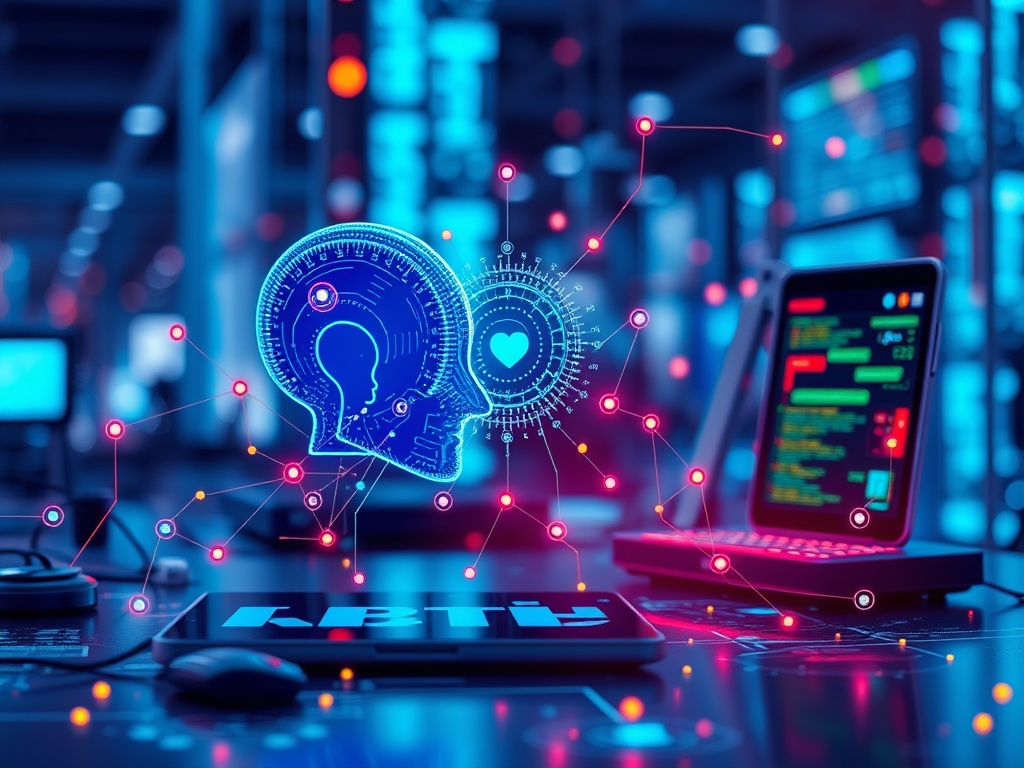
Edge AI Intelligence on IoT Devices
The proliferation of Internet of Things (IoT) devices has ushered in an era of unprecedented connectivity, generating vast oceans of data from every corner of our world. From smart homes to industrial complexes, billions of sensors are constantly collecting information. Traditionally, much of this data would be streamed to centralized cloud servers for processing and analysis. However, this model faces significant limitations in terms of latency, bandwidth, privacy, and reliability. Enter Edge AI – a paradigm shift that brings artificial intelligence directly to the IoT devices themselves, enabling real-time decision-making and transforming how we interact with the intelligent edge. This fusion of AI and IoT is not just an evolution; it's a revolution in distributed intelligence.
What is Edge AI and Why it Matters for IoT?
Edge AI refers to the process of running artificial intelligence algorithms directly on local devices or "edge" nodes, rather than relying solely on cloud-based servers. In the context of IoT, this means that devices like sensors, cameras, and embedded systems can perform complex AI tasks such as object recognition, anomaly detection, and natural language processing right where the data is generated. Unlike traditional cloud AI, where raw data is sent to a remote data center for processing and then results are sent back, Edge AI allows for immediate analysis and action. This localized processing is crucial for IoT applications that demand instant responses, operate in environments with limited connectivity, or handle sensitive data that should not leave the device. The ability to execute sophisticated AI models on resource-constrained IoT hardware signifies a monumental leap in the capabilities and autonomy of connected devices, making them smarter and more responsive than ever before.
Key Benefits of Integrating Edge AI into IoT Ecosystems
The convergence of Edge AI and IoT unlocks a myriad of benefits that address the inherent challenges of large-scale, distributed intelligent systems. By pushing intelligence to the periphery, organizations can achieve greater efficiency, enhanced security, and superior performance across their IoT deployments. These advantages are pivotal for developing robust, scalable, and resilient smart solutions across various industries.
- Latency Reduction: Processing data locally eliminates the round-trip journey to the cloud, drastically cutting down response times. This is critical for applications like autonomous vehicles, industrial automation, and real-time medical monitoring, where milliseconds can make a significant difference in safety and operational efficiency. Decisions can be made instantly, enabling truly responsive systems.
- Bandwidth Optimization: Edge AI reduces the volume of data transmitted over networks. Instead of sending all raw data to the cloud, only processed insights or critical alerts are transmitted, if at all. This not only lowers bandwidth costs but also alleviates network congestion, making IoT deployments more scalable and less reliant on high-speed, constant connectivity.
- Enhanced Security & Privacy: Keeping sensitive data on the device or local network minimizes exposure to potential cyber threats associated with cloud transfers. For applications dealing with personal health information, financial data, or proprietary industrial processes, local processing significantly strengthens data privacy compliance and reduces the attack surface, building greater trust in IoT solutions.
- Operational Reliability: Edge AI systems can operate autonomously even when network connectivity to the cloud is intermittent or completely lost. This ensures continuous operation for critical infrastructure, remote monitoring systems, and devices in challenging environments, providing resilience and uninterrupted service irrespective of network conditions.
Technical Challenges and Considerations for Edge AI on IoT
While the benefits of Edge AI on IoT are compelling, its implementation is not without significant technical hurdles. The fundamental constraint lies in the inherent differences between powerful cloud servers and resource-limited IoT devices. Overcoming these challenges requires innovative approaches in hardware design, software optimization, and system architecture to truly unleash the potential of intelligence at the edge. Addressing these considerations is vital for successful and sustainable Edge AI deployments across diverse IoT landscapes.
One primary challenge is the severe resource limitation of IoT devices. They typically have constrained processing power, limited memory, and strict power budgets, often relying on batteries for extended periods. Running complex deep learning models, which are traditionally resource-intensive, on such devices demands extreme model optimization, compression techniques, and the development of specialized, energy-efficient AI accelerators. Furthermore, deploying and managing AI models across a vast and heterogeneous fleet of IoT devices presents its own complexities. This includes ensuring compatibility across different hardware architectures, facilitating secure over-the-air (OTA) updates for models and firmware, and monitoring model performance and drift in real-time. Data privacy and security also become more intricate as processing moves closer to the source, requiring robust encryption and access control mechanisms at the edge. Finally, debugging and troubleshooting issues on remote, often headless, IoT devices running AI models require sophisticated remote management tools and diagnostic capabilities, adding another layer of complexity to the operational lifecycle.
Real-World Applications Revolutionized by Edge AI on IoT
The practical implications of Edge AI on IoT devices are vast, spanning across numerous industries and transforming how businesses operate and how individuals interact with their environment. From enhancing safety to improving efficiency, Edge AI is enabling a new generation of smart, responsive, and autonomous systems. These applications highlight the diverse impact and immense potential of bringing intelligence to the data source.
In Smart Cities, Edge AI on IoT cameras can analyze traffic patterns in real-time, optimizing traffic light timings to reduce congestion and emissions without sending sensitive video feeds to the cloud. For public safety, edge devices can detect unusual activity or potential threats, alerting authorities instantly. In the realm of Industrial IoT (IIoT), Edge AI monitors machinery for anomalies, predicting maintenance needs before failures occur, thereby preventing costly downtime and improving operational efficiency. Quality control systems use edge vision AI to inspect products on assembly lines at high speeds. Healthcare benefits from wearables with Edge AI that can monitor vital signs and detect medical emergencies, providing immediate alerts without constant cloud connectivity, safeguarding patient privacy. In Autonomous Vehicles, Edge AI is indispensable for real-time object detection, pedestrian recognition, and decision-making, where even a millisecond of latency can have critical consequences. Finally, Smart Retail leverages Edge AI for intelligent inventory management, tracking shelf stock, and analyzing customer foot traffic patterns to optimize store layouts and personalized shopping experiences, all while maintaining privacy by processing data locally.
The Future Landscape: Trends and Innovations in Edge AI for IoT
The field of Edge AI on IoT is rapidly evolving, driven by continuous innovation in hardware, software, and AI algorithms. As demand for distributed intelligence grows, several key trends are shaping the future landscape, promising even more powerful, efficient, and versatile applications. These advancements are set to overcome current limitations and unlock unprecedented capabilities for intelligent IoT ecosystems, pushing the boundaries of what is possible at the network's edge.
One significant trend is the rise of TinyML, which focuses on bringing deep learning to extremely low-power microcontrollers and embedded devices. This enables AI capabilities in devices with severe resource constraints, opening doors for pervasive intelligence in even the smallest IoT sensors. Concurrently, hardware advancements are crucial, with specialized AI accelerators like Neural Processing Units (NPUs) and Vision Processing Units (VPUs) becoming more powerful and energy-efficient, designed specifically to execute AI models on the edge. Another emerging paradigm is Federated Learning, where AI models are trained collaboratively across multiple edge devices without the need to centralize raw data. This approach significantly enhances data privacy and reduces bandwidth requirements, making it ideal for sensitive applications. Furthermore, advancements in model compression techniques, such as quantization and pruning, are making larger, more complex AI models viable for edge deployment. The integration of 5G networks will also play a pivotal role, providing the high bandwidth and ultra-low latency necessary for seamless communication between edge devices and localized edge servers, further decentralizing computational power. These combined innovations are paving the way for a hyper-intelligent, interconnected world where AI is truly ubiquitous.
Conclusion
Edge AI intelligence on IoT devices represents a pivotal shift in how we conceive and deploy intelligent systems. By bringing advanced analytics and machine learning capabilities directly to the source of data generation, it effectively addresses the critical limitations of traditional cloud-centric models, offering unparalleled benefits in terms of latency, bandwidth efficiency, security, privacy, and operational reliability. While technical challenges related to resource constraints and model optimization persist, ongoing innovations in hardware, TinyML, and federated learning are rapidly expanding the possibilities. The transformative impact of Edge AI is already evident across diverse sectors, from smart cities and industrial automation to healthcare and autonomous vehicles, fundamentally redefining the capabilities of connected devices. As the IoT landscape continues its exponential growth, Edge AI will undeniably serve as the cornerstone for a truly intelligent, responsive, and autonomous future. Stay ahead of the curve by exploring more insights on AI, machine learning, and emerging technologies with AI Insights.



Aucun commentaire:
Enregistrer un commentaire