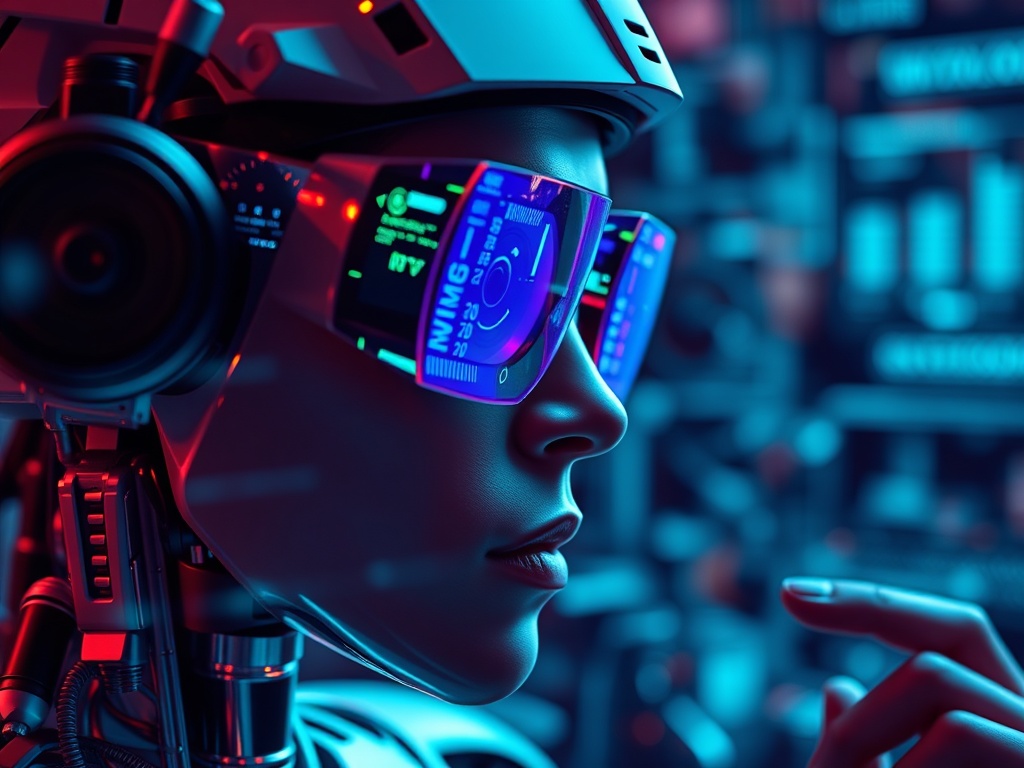
Multimodal AI: Unifying Vision, Text, and Audio for a Smarter Future
In the rapidly evolving landscape of artificial intelligence, the quest for machines that can understand and interact with the world in a more human-like way has led to the emergence of multimodal AI. Moving beyond systems that specialize in a single data type, multimodal AI integrates and processes information from various senses simultaneously – primarily vision, text, and audio. This convergence represents a profound shift, enabling AI models to perceive context, nuance, and relationships across different forms of data, much like humans do. The ability to synthesize insights from what it sees, reads, and hears is unlocking unprecedented capabilities, pushing the boundaries of machine learning and deep learning applications across countless industries.
The Foundation of Multimodality: Beyond Single-Sense AI
For years, AI systems have excelled in specific domains, mastering tasks within a single modality. Image recognition models accurately identify objects, natural language processing (NLP) models understand and generate text, and speech recognition systems transcribe spoken words. While impressive, these unimodal AIs operate in silos, lacking a holistic understanding of real-world scenarios where information is rarely presented in isolation. A text description of a scene might mention a "red car," but an image provides the visual context, and the sound of an "engine revving" adds another layer of dynamic information. Multimodal AI bridges these gaps by enabling systems to interpret and correlate data streams from vision, text, and audio inputs. This approach mirrors the intricate way human brains process sensory information, allowing for a richer, more nuanced comprehension of complex environments and interactions, fundamentally transforming how AI perceives and responds to its surroundings.
How Vision, Text, and Audio Converge
The core challenge in multimodal AI lies in effectively integrating disparate data types, each with its unique structure and representation. Vision data (images, videos) is typically high-dimensional and spatial, text data (words, sentences) is symbolic and sequential, and audio data (speech, environmental sounds) is temporal and waveform-based. To achieve convergence, advanced deep learning architectures are employed to extract meaningful features from each modality and then fuse them into a unified, coherent representation. This often involves creating shared embedding spaces where concepts from different modalities can be compared and understood. For instance, an image of a cat, the word "cat," and the sound of a "meow" would all be mapped to proximate points in this shared space. The fusion process can occur at various stages, from early concatenation of raw features to more sophisticated late fusion of high-level semantic representations, guided by sophisticated attention mechanisms that weigh the importance of different modal inputs. This intricate process of data alignment and integration is critical for enabling AI to build a comprehensive understanding of complex information.
- Cross-modal Embeddings: Transforming raw data from different modalities into a common, dense vector space where semantic similarities can be directly computed, allowing for direct comparison and understanding across modalities.
- Attention Mechanisms: Enabling the AI model to selectively focus on the most relevant parts of the input from each modality, dynamically weighing their importance when making predictions or generating outputs.
- Generative Models: Utilizing multimodal inputs to synthesize new content, such as generating text descriptions from images, creating images from text and audio cues, or even generating realistic speech from text and emotion indicators.
- Transfer Learning: Leveraging knowledge gained from training on one modality (e.g., pre-trained language models) and applying it to another, or to a multimodal task, significantly improving efficiency and performance.
Revolutionizing Interaction: Applications of Multimodal AI
The practical implications of multimodal AI are vast and transformative, touching nearly every sector. In healthcare, multimodal systems can analyze medical images (vision), patient records (text), and even vocal biomarkers (audio) to assist in more accurate diagnoses, predict disease progression, and personalize treatment plans. Autonomous vehicles are another prime example, relying on the fusion of lidar, radar, camera feeds (vision), GPS data (text), and the sounds of emergency sirens or honking horns (audio) to navigate safely and make critical real-time decisions. For human-computer interaction, multimodal AI promises truly natural and intuitive interfaces. Imagine conversational agents that not only understand your spoken words but also interpret your facial expressions and tone of voice to gauge your mood and respond more empathetically. In education, it can create adaptive learning environments that respond to a student's engagement levels, understanding of content, and verbal queries. From advanced robotics to smart cities and creative content generation, multimodal AI is paving the way for systems that are more intelligent, perceptive, and deeply integrated into our daily lives, offering unparalleled levels of understanding and interaction.
The Technical Underpinnings: Deep Learning and Fusion Strategies
At the heart of multimodal AI are advanced deep learning architectures capable of processing and integrating diverse data types. Convolutional Neural Networks (CNNs) remain pivotal for extracting spatial features from images and video, while Transformer models, originally developed for natural language processing, have proven highly effective for sequential data like text and audio, due to their robust attention mechanisms. For multimodal tasks, these specialized encoders often work in tandem. For instance, a visual encoder (e.g., a Vision Transformer) might process an image, while a text encoder (e.g., a BERT variant) handles accompanying text. The outputs of these individual encoders are then fed into a fusion layer. Fusion strategies can vary significantly: "early fusion" combines features at a low level, often concatenating them before passing them to a unified network; "late fusion" processes each modality independently up to a high-level representation, merging only the final predictions or semantic embeddings; "joint fusion" aims to learn a shared representation directly from raw multimodal inputs. These strategies, combined with sophisticated training techniques and massive datasets, enable multimodal models to learn intricate correlations between different sensory inputs, allowing them to understand context and generate coherent, cross-modal responses. The development of specialized architectures like CLIP (Contrastive Language-Image Pre-training) and models like GPT-4V (GPT-4 with Vision) exemplify the power of these integrated approaches.
Challenges and the Road Ahead for Multimodal AI
Despite its remarkable progress, multimodal AI still faces significant challenges that researchers are actively addressing. One primary hurdle is data scarcity; creating large, high-quality datasets that perfectly align visual, textual, and audio information is complex and resource-intensive. Ensuring precise synchronization across modalities, especially for real-time applications, presents another technical difficulty. Computational demands are also substantial, as processing and fusing multiple data streams require immense processing power and memory, making deployment on edge devices challenging. Furthermore, the interpretability of these complex models remains a concern; understanding why a multimodal AI makes a particular decision can be difficult when multiple inputs are considered. Ethical considerations are paramount, including issues of bias propagation from individual modalities into the combined system, and privacy concerns related to collecting and analyzing diverse personal data. Looking ahead, the focus will be on developing more robust and generalizable multimodal models that require less data, improving efficiency for real-time applications, and enhancing interpretability to build trust. Research into self-supervised learning and few-shot learning for multimodal tasks will be crucial. Addressing these challenges will pave the way for even more sophisticated, ethically sound, and pervasive multimodal AI systems that truly augment human capabilities and reshape our interaction with technology.
Conclusion
Multimodal AI represents a pivotal leap in the evolution of artificial intelligence, transitioning from specialized, single-sense systems to holistic, human-like perception. By seamlessly integrating information from vision, text, and audio, these advanced models gain a richer, more contextual understanding of the world, mirroring the intricate way humans interact with their environment. This convergence is not merely a technical advancement; it's a paradigm shift that promises to revolutionize industries from healthcare and autonomous systems to human-computer interaction. While challenges in data, computation, and ethics persist, the ongoing innovation in deep learning and fusion strategies is rapidly overcoming these hurdles. The future of AI is undeniably multimodal, leading to more intuitive, intelligent, and impactful technologies that will profoundly shape our digital and physical realities. Continue exploring the cutting-edge developments in this transformative field with AI Insights.



Aucun commentaire:
Enregistrer un commentaire