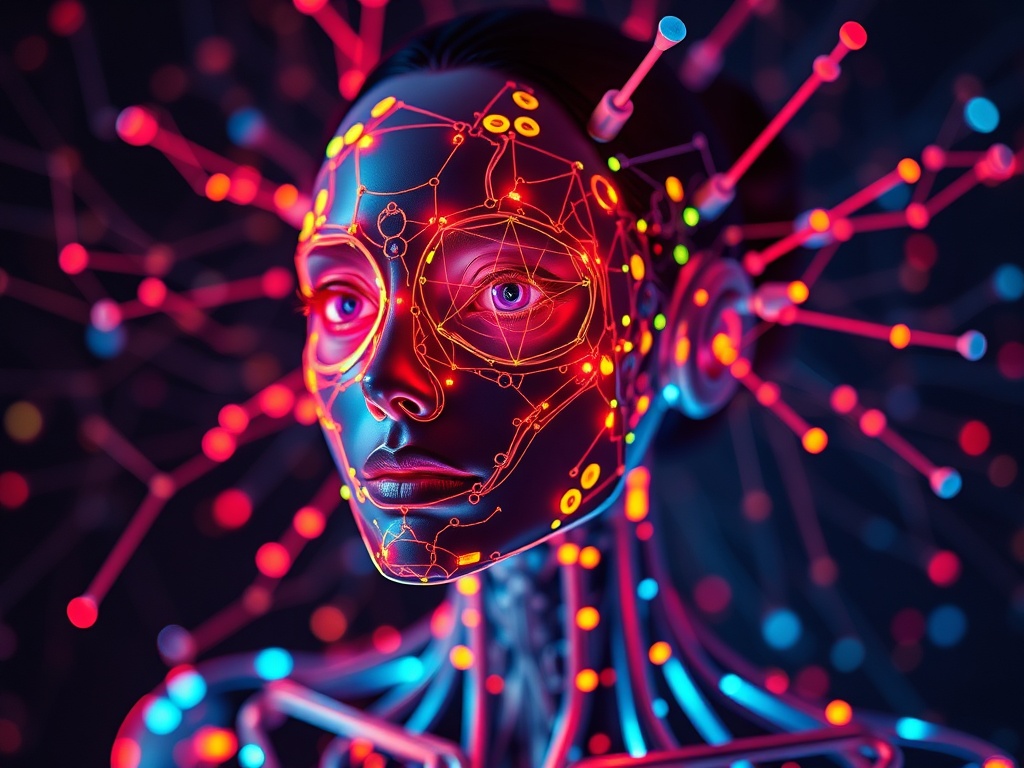
Generative AI in Creative Industries: Reshaping Art, Design & Media
The landscape of creativity is undergoing a profound transformation, spearheaded by the rapid evolution of generative artificial intelligence. Once confined to the realm of science fiction, AI models capable of producing novel content—be it images, text, music, or even code—are now powerful tools in the hands of artists, designers, and innovators across various sectors. This paradigm shift is not merely about automation; it's about augmenting human potential, fostering unprecedented levels of experimentation, and opening up entirely new avenues for artistic expression and commercial application. Generative AI is no longer just a technological marvel; it's a creative partner, redefining the boundaries of what's possible in the creative industries.
Reshaping Artistic Expression and Music Composition
Generative AI is fundamentally altering how artists conceive and execute their work, offering a boundless canvas for exploration. Tools powered by models like DALL-E, Midjourney, and Stable Diffusion allow artists to generate intricate visual concepts from simple text prompts, pushing the boundaries of traditional painting, digital art, and even sculpture. This capability enables rapid prototyping of ideas, instant stylistic variations, and the creation of entirely new aesthetic forms that might be impossible or prohibitively time-consuming for humans alone. Beyond static images, AI is venturing into dynamic media, assisting in animation frame generation, visual effects, and interactive art installations that react in real-time to external stimuli.
In the realm of music, generative AI is equally revolutionary. Algorithms can compose original melodies, harmonies, and rhythms in various genres, often learning from vast datasets of existing music. Musicians are leveraging AI to overcome creative blocks, experiment with novel soundscapes, or even generate backing tracks for their compositions. This doesn't diminish the role of human composers; rather, it provides a sophisticated co-creator, expanding their palette of tools and enabling them to explore musical ideas with unparalleled speed and versatility. The synergy between human intuition and AI's computational power is forging new genres and revitalizing existing ones, democratizing music creation for a wider audience.
Revolutionizing Design and Media Production Workflows
The impact of generative AI extends deeply into the practical workflows of design and media production, streamlining processes and fostering unparalleled efficiency. From graphic design to video editing and game development, AI-powered tools are becoming indispensable, accelerating iteration cycles and freeing up human creatives to focus on higher-level conceptual tasks. This isn't about replacing designers or editors but empowering them with capabilities that were previously unimaginable, allowing for rapid experimentation with visual styles, layouts, and interactive elements. The ability to quickly generate multiple design variations or complex animations significantly cuts down on production time and costs, making sophisticated content creation more accessible.
Consider the benefits across various facets of media production:
- Graphic Design: AI can generate countless logo variations, create unique typography, design intricate patterns, and even produce entire marketing campaigns from a few keywords, significantly reducing the time spent on repetitive tasks and allowing designers to explore a broader spectrum of creative possibilities.
- Video and Animation: Generative AI assists in creating storyboards, generating realistic or stylized character animations, synthesizing voiceovers, and even producing entire scenes or special effects, dramatically speeding up the notoriously time-consuming animation pipeline and enhancing visual fidelity.
- Game Development: AI can autonomously generate vast open-world environments, intricate textures, character models, and even non-player character (NPC) behaviors, enriching game worlds and reducing the manual effort required for asset creation, allowing developers to focus on core gameplay mechanics and narrative.
- Personalized Content Creation: For advertising and media, AI can tailor content to individual user preferences at scale, generating personalized ads, social media posts, or news summaries, leading to higher engagement rates and more effective communication strategies by understanding audience nuances.
The AI-Human Creative Partnership: A New Frontier
Far from replacing human creativity, generative AI is ushering in an era of unprecedented collaboration between humans and machines. This partnership is not merely about automation but about augmentation, where AI serves as an intelligent assistant, a co-pilot that expands the human creative mind. Artists, writers, musicians, and designers are increasingly leveraging AI as a brainstorming partner, a rapid prototyping tool, or a source of unexpected inspiration. AI can generate thousands of ideas in seconds, allowing the human creator to curate, refine, and imbue the output with their unique vision, emotional depth, and nuanced understanding that only human experience can provide.
This symbiotic relationship redefines the creative process itself. Instead of starting from a blank slate, creatives can begin with AI-generated foundations, iterate rapidly, and steer the AI towards their desired outcome. The focus shifts from the manual execution of tasks to the strategic direction and curation of AI-generated content. For instance, a writer might use AI to generate different plotlines or character dialogues, then weave them into a cohesive narrative. A designer might use AI to produce countless variations of a logo, selecting the most compelling ones to refine. This partnership empowers creatives to overcome limitations, explore more diverse ideas, and ultimately produce higher-quality, more innovative work that blends the best of both artificial intelligence and human ingenuity.
Challenges and Ethical Considerations in AI-Driven Creativity
While generative AI promises immense opportunities, its rapid integration into creative industries also brings a host of complex challenges and pressing ethical considerations that demand careful navigation. One of the most significant concerns revolves around copyright and intellectual property. When AI models are trained on vast datasets of existing copyrighted works, questions arise about who owns the output generated by these models, especially if the output bears resemblance to the training data. This legal ambiguity creates uncertainty for creators and content owners, necessitating new frameworks for attribution, ownership, and fair use in the age of AI.
Another critical issue is the potential for job displacement. While AI is framed as an augmentation tool, there are legitimate fears that certain creative roles, particularly those involving repetitive or highly skilled but formulaic tasks, could be significantly impacted. Furthermore, the question of authenticity and originality is paramount. As AI-generated content becomes indistinguishable from human-made work, how do we value artistic skill, human effort, and genuine creative intent? The potential for deepfakes and misinformation also looms large, challenging the very foundation of truth and trust in media. Addressing these challenges requires a multi-faceted approach involving technological safeguards, evolving legal standards, and an ongoing dialogue within the creative community about responsible AI development and deployment.
Future Outlook: Expanding Creative Horizons and Accessibility
The future of generative AI in creative industries is poised for exponential growth, promising to unlock unprecedented levels of creativity, accessibility, and innovation. As AI models become more sophisticated, intuitive, and multimodal, their capabilities will extend beyond generating static content to creating dynamic, interactive, and immersive experiences. We can anticipate AI tools that seamlessly integrate into existing creative software, offering real-time assistance and predictive capabilities that anticipate a creator's next move. This will further democratize access to high-quality creative tools, enabling individuals without extensive technical or artistic training to bring their visions to life, fostering a new wave of citizen creators.
Moreover, generative AI will likely play a pivotal role in creating hyper-personalized content at scale, from customized marketing campaigns to adaptive entertainment experiences that evolve with individual viewer preferences. The boundaries between different creative disciplines will blur even further, as AI facilitates the seamless conversion of ideas across mediums – a text prompt generating a 3D model, which then animates itself and composes its own soundtrack. This evolution will not only foster entirely new art forms and entertainment categories but also streamline production processes across industries, making complex creative projects more viable and cost-effective. The future envisions AI as an omnipresent creative catalyst, continuously expanding the horizons of human imagination.
Conclusion
Generative AI stands as a transformative force, fundamentally reshaping the creative industries and redefining the very essence of artistry and design. From revolutionizing artistic expression and music composition to streamlining complex media production workflows, AI is proving to be an indispensable partner for human creativity. While it presents exciting opportunities for collaboration and innovation, we must also proactively address the critical challenges surrounding copyright, authenticity, and ethical deployment. As AI models continue to evolve, the synergy between human ingenuity and artificial intelligence will undoubtedly lead to unprecedented creative output, making sophisticated tools more accessible and fostering new forms of expression. The journey of generative AI in creativity is just beginning, and its potential for innovation remains boundless. Explore more about the latest AI trends and their impact on various sectors by staying tuned to AI Insights.



Aucun commentaire:
Enregistrer un commentaire