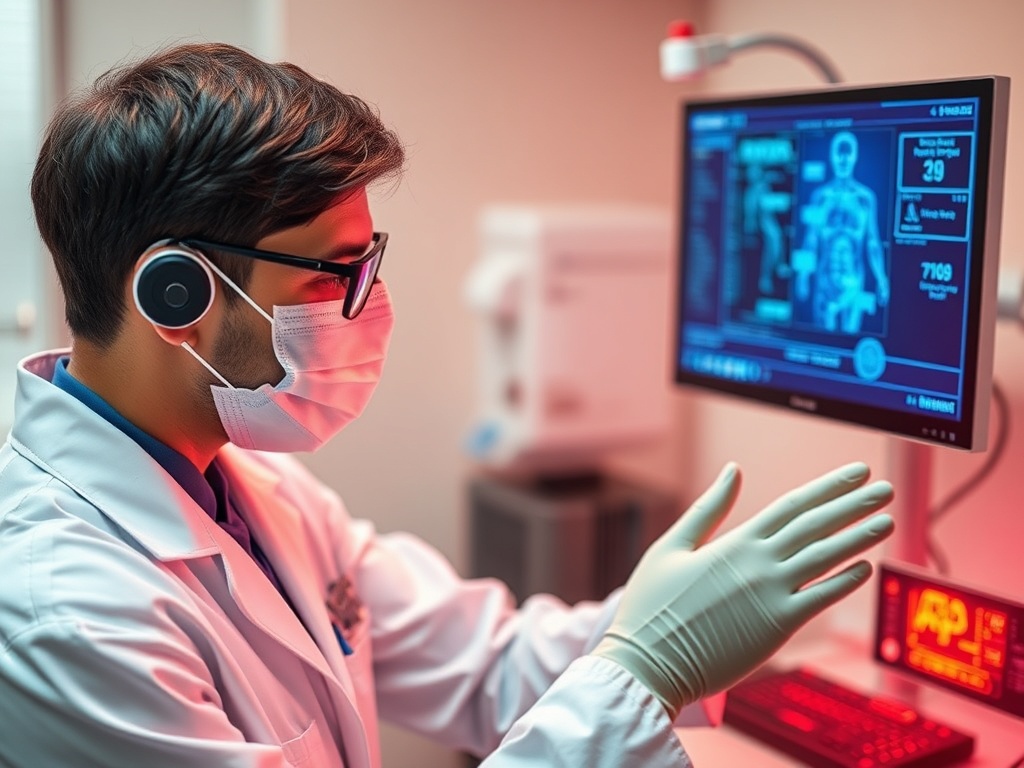
AI Transforming Healthcare Diagnostics: Precision, Speed, and Predictive Power
Artificial intelligence (AI) is rapidly emerging as a transformative force across various sectors, and healthcare diagnostics stands out as one of its most impactful applications. The ability of AI and its subfields, machine learning and deep learning, to process vast amounts of complex data at unprecedented speeds is fundamentally reshaping how diseases are detected, understood, and treated. From enhancing the accuracy of medical imaging interpretations to enabling proactive disease prediction, AI is not merely augmenting human capabilities but is pioneering a new era of diagnostic medicine. This shift promises to deliver more precise, efficient, and personalized healthcare solutions, ultimately leading to improved patient outcomes globally.
The Imperative for AI in Modern Diagnostics
The traditional landscape of healthcare diagnostics, while foundational, faces significant challenges that AI is uniquely positioned to address. The sheer volume of medical data generated daily – from electronic health records (EHRs), laboratory results, and genetic sequencing to an ever-growing array of medical images – often overwhelms human capacity for analysis. This data overload can lead to missed diagnoses, delayed treatments, and increased healthcare costs. Furthermore, diagnostic accuracy can be influenced by human factors such as fatigue, experience levels, and subjective interpretation, resulting in variability and potential errors. AI offers a robust solution by introducing unparalleled computational power and analytical precision. Machine learning algorithms can sift through colossal datasets to identify subtle patterns, anomalies, and correlations that might escape the human eye, thereby enhancing diagnostic reliability and speed. This capability is critical in an era where early and accurate diagnosis is paramount for effective disease management and patient survival, especially for complex conditions like cancer and neurodegenerative diseases. The imperative for AI in diagnostics is thus driven by the need for greater efficiency, accuracy, and scalability in healthcare delivery.
AI's Pivotal Role in Medical Imaging Analysis
One of the most profound impacts of AI in diagnostics is its application in medical imaging. Deep learning, particularly convolutional neural networks (CNNs), has demonstrated remarkable prowess in analyzing complex visual data, making it an ideal tool for interpreting X-rays, CT scans, MRIs, and other diagnostic images. These algorithms are trained on millions of labeled images, learning to identify specific features indicative of various diseases with remarkable accuracy. This not only aids radiologists and pathologists but also helps in standardizing interpretations across different healthcare settings, reducing inter-observer variability. AI systems can rapidly screen images, flag suspicious areas for closer human review, and even quantify disease progression, thereby streamlining workflows and allowing medical professionals to focus on complex cases requiring nuanced human judgment. The integration of AI in imaging significantly accelerates the diagnostic process, leading to quicker patient management and improved clinical outcomes across numerous medical specialties.
- Radiology: AI algorithms assist in detecting subtle anomalies in X-rays, CT, and MRI scans, identifying early signs of lung nodules, brain tumors, fractures, and cardiovascular conditions that might be overlooked. This enhances diagnostic accuracy and reduces the time required for image interpretation.
- Pathology: In digital pathology, AI analyzes microscopic images of tissue biopsies to detect cancerous cells, grade tumors, and identify biomarkers. This accelerates diagnosis, provides objective assessments, and assists pathologists in managing high volumes of samples efficiently.
- Ophthalmology: AI-powered systems can analyze retinal scans to identify early indicators of diabetic retinopathy, glaucoma, and age-related macular degeneration. Early detection through AI can prevent irreversible vision loss by enabling timely intervention and treatment.
- Dermatology: Machine learning models are highly effective in classifying skin lesions from images, distinguishing between benign moles and potentially malignant melanoma. This capability provides rapid preliminary assessments, guides referrals to specialists, and reduces unnecessary biopsies.
Predictive Analytics and Early Disease Detection
Beyond interpreting current symptoms and images, AI excels in predictive analytics, offering the potential to forecast disease onset long before symptoms manifest. By integrating and analyzing diverse datasets – including genomic information, electronic health records, lifestyle factors, environmental exposures, and even wearable device data – AI algorithms can identify individuals at high risk for developing specific conditions. For example, machine learning models can predict the likelihood of sepsis in critically ill patients, forecast cardiovascular events, or identify individuals predisposed to diabetes or certain cancers based on their genetic makeup and historical health data. This proactive approach transforms healthcare from a reactive model, focused on treating existing illness, to a preventive one. Early detection powered by AI allows for timely interventions, personalized prevention strategies, and lifestyle modifications that can significantly alter disease trajectories, improve quality of life, and reduce the burden on healthcare systems. The ability to identify at-risk populations enables targeted screening programs and resource allocation, making healthcare more efficient and impactful.
Precision Medicine and Personalized Treatment Plans
The advent of AI is a cornerstone in the evolution of precision medicine, moving healthcare beyond a one-size-fits-all approach to highly individualized treatment plans. AI algorithms can analyze a patient’s unique biological profile, including their genetic makeup, proteomic data, metabolic responses, and even microbiome composition, alongside their disease subtype and medical history. This comprehensive analysis allows AI to identify the most effective therapies, predict drug efficacy, anticipate potential adverse reactions, and optimize dosages for individual patients. In oncology, for instance, AI can scour vast databases of scientific literature, clinical trials, and genomic data to recommend personalized cancer treatments, identify suitable clinical trials, and even aid in the discovery of novel therapeutic targets. For autoimmune diseases or rare conditions, where diagnosis and treatment can be particularly challenging, AI provides clinicians with data-driven insights to tailor interventions precisely. By personalizing treatment pathways, AI not only maximizes the chances of successful outcomes but also minimizes ineffective treatments and associated side effects, marking a significant leap forward in patient-centered care.
Challenges and Ethical Considerations in AI Diagnostics
While the promise of AI in healthcare diagnostics is immense, its widespread adoption also brings forth a spectrum of challenges and ethical considerations that demand careful attention. Data privacy and security remain paramount, as AI systems rely on access to sensitive patient information, necessitating robust safeguards to comply with regulations like HIPAA and GDPR. Another critical concern is algorithmic bias; if training data reflects existing healthcare disparities or is unrepresentative of diverse populations, AI models can perpetuate or even exacerbate these biases, leading to inaccurate diagnoses or suboptimal treatment recommendations for certain groups. Regulatory approval and validation are also complex, as AI diagnostic tools must undergo rigorous testing to ensure their safety, efficacy, and reliability before clinical deployment. Furthermore, the integration of AI into existing clinical workflows requires careful planning and physician acceptance. Clinicians need to trust these tools and understand their limitations, viewing AI as an assistive technology rather than a replacement for human expertise. Finally, the "black box" nature of some advanced AI models, where the reasoning behind a decision isn't transparent, poses challenges for accountability and interpretability, especially in high-stakes diagnostic scenarios. Addressing these challenges through responsible AI development, transparent validation, and ethical guidelines is crucial for realizing AI's full potential in healthcare.
Conclusion
Artificial intelligence is undeniably revolutionizing healthcare diagnostics, ushering in an era characterized by unprecedented precision, speed, and predictive capabilities. From transforming medical imaging analysis and enabling early disease detection through sophisticated predictive analytics to personalizing treatment plans for optimal patient outcomes, AI is proving to be an indispensable tool. While challenges related to data privacy, algorithmic bias, and ethical integration persist, ongoing advancements and responsible development are steadily paving the way for AI to augment human expertise, making healthcare more accessible, efficient, and tailored to individual needs. The future of diagnostics is intrinsically linked with AI, promising a healthier tomorrow for all. Explore how AI Insights is shaping the conversation around these technological advancements and their impact on our world.



Aucun commentaire:
Enregistrer un commentaire